Interests
Hiking in Bali: volcanoes, valleys and rice fields, level by level
In Bali, hiking takes two very different forms. The volcanoes, Batur and Agung, are climbed at night to watch the day break from the summit. The valleys and rice fields, in Sidemen, Munduk or Jatiluwih, are walked in the morning, without major elevation gain, at the pace of the villages and the irrigation channels.
- Updated on
- 6 min read
- By Kylian Dev
Contents
Key points
- Mount Batur: summit at 1,717 m, departure around 3 a.m., about 2 h of climbing and 400 m of elevation gain.
- Mount Agung: far more demanding, for trained walkers, with a guide, and not recommended in the rainy season.
- Sidemen, Munduk and Jatiluwih: easy to moderate walks in the rice fields and forests, in the morning.
- Dry season for the volcanoes; in the rainy season, the summits are often in the clouds at sunrise.
This guide compares the five best-known walks in Bali, from the easiest to the most demanding. It gives no guide prices: prices vary with group size, transport included and the season. Durations and altitudes are orders of magnitude, taken from our fact sheet, and do not replace a local guide’s briefing.
If volcanoes attract you more than rice fields, the Bali or Lombok comparison sets Batur against Rinjani, the great volcano of the neighboring island.
The five Bali hikes compared
Batur is the most accessible volcano hike: a night climb of about two hours. Agung is a real ascent, reserved for trained walkers. Sidemen and Jatiluwih are walked without difficulty in the rice fields. Munduk adds forests, waterfalls and steep steps. Only the volcanoes start at night.
| Hike | Difficulty | Start | Guide | Best season |
|---|---|---|---|---|
| Mount Batur | Moderate | Around 3 a.m. | Advised, common practice | Dry season |
| Mount Agung | Difficult | At night | Essential | Dry season, outside ceremonies |
| Sidemen | Easy | Early morning | Useful, not essential | End of the rains, dry season |
| Munduk | Easy to moderate | Morning | Useful for the trails | Heart of the dry season |
| Jatiluwih | Easy | Morning | Not necessary | All year, green rice fields at the end of the rains |
These walks are spread over three regions: Batur and Agung northeast of the center, Sidemen in the east, Munduk and Jatiluwih in the central and northern highlands. You do not do them all from the same base: driving times between the east and the north are long.
Mount Batur at sunrise
Batur rises to 1,717 m. You leave around 3 a.m. from a village at about 1,300 m, for about 2 h of climbing and 400 m of elevation gain, and watch the day break above the lake and the lava flows. It is demanding but accessible to a fit walker.
Altitude of the Batur summit
1,717 m
Source: BaliWanderer fact sheet
Duration of the climb, departure around 3 a.m.
≈ 2 h
Source: BaliWanderer fact sheet
Elevation gain from the starting village, at about 1,300 m
≈ 400 m
Source: BaliWanderer fact sheet
The climb is done at night, by headlamp, on a trail of volcanic soil that slides in the last section. Most walkers go up with a local guide, who knows the trail and organizes the departure; access rules have varied over the years, so ask your accommodation before setting off without one.
Mount Agung: an ascent for trained walkers
Agung, Bali’s highest volcano and a sacred mountain, is climbed at night, on a long and steep trail, far more demanding than Batur. A guide is essential. The ascent is not recommended in the rainy season and may be closed during certain ceremonies, notably at Besakih, on its slopes.
Who it suits
- Trained walkers, used to long climbs and steep descents.
- Those who go in the dry season, with a few days of margin for the weather.
- Those who accept climbing with a guide and following their decisions.
Who it does not suit
- Beginner hikers and children.
- Travelers who go in the rainy season, when the summit is often in the clouds.
- Those who have only one possible date: a ceremony or the weather can cancel everything.
Agung is the most sacred mountain on the island: Besakih temple, the mother temple, is on its slopes. The guide knows the periods when the ascent is not possible, and the rules to respect along the way. The trails and the level required are discussed with them before booking.
Sidemen, Munduk, Jatiluwih: walking in the rice fields
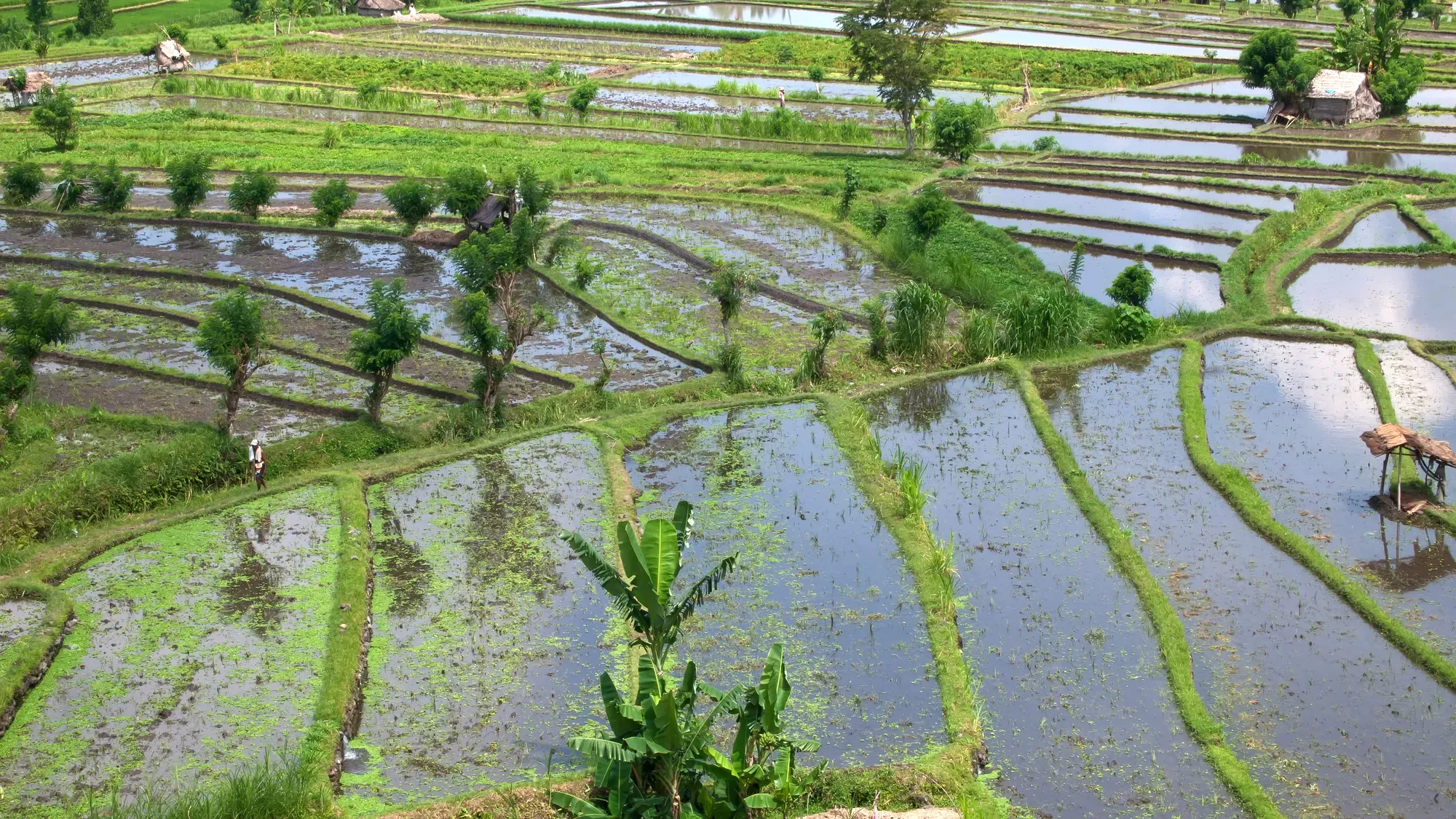
Sidemen offers easy walks in a valley of rice fields facing Agung. Munduk adds forest, coffee and clove plantations and waterfalls at the end of steep trails. Jatiluwih, listed by UNESCO with the subak system, unfolds vast terraces crossed by marked paths, without difficulty.
Sidemen
Walks on the dykes and paths of the valley, at the foot of Agung, between weaving villages. In the morning, when the volcano clears. See Sidemen.
Munduk
Loop of the Munduk, Melanting and Golden Valley waterfalls from the village, forest trails above Lake Tamblingan. Slippery steps after rain. See Munduk.
Jatiluwih
The World Heritage terraces, larger and calmer than Tegalalang. Half a day with the drive. An entrance contribution is generally requested.
In the rice fields, you walk on cultivated land: stay on the paths and dykes, do not trample the plants, and greet the farmers. A village guide is not compulsory, but avoids getting lost and explains how the subak work. The journey to the northern highlands is on Ubud → Munduk.
Gear for a hike in Bali
For the volcanoes: closed shoes with a grippy sole, headlamp, warm layer and windbreaker for the summit, water and snacks. For the valleys: closed shoes, hat, sunscreen, repellent and rain protection. Everywhere, plenty of water and a charged phone.
| Equipment | Volcanoes (Batur, Agung) | Valleys and rice fields |
|---|---|---|
| Shoes | Closed, grippy sole | Closed; walking sandals on dry paths |
| Clothing | Warm layer and windbreaker for the summit | Light, covering against sun and mosquitoes |
| Light | Headlamp essential | Not needed |
| Water | Several bottles, rehydration salts | One bottle, filled at the accommodation |
| Rain | Waterproof jacket | Poncho or umbrella |
The Munduk waterfalls are reached by slippery steps: setting off in flip-flops is the leading cause of falls. The full list, adapted to your month of departure, is prepared with the packing tool.
Weather and season: when to hike in Bali
The dry season, from about April to October, offers dry trails and summits more often clear at sunrise. April and May combine practicable trails and green landscapes. In the rainy season, Batur remains doable with no guarantee of a view, Agung is not recommended, and you walk early before the showers.
- April: Batur clears more often, Agung becomes feasible again with a guide, Sidemen and Munduk are good for walking.
- July and August: conditions among the best, maximum crowds on Batur, a warm layer essential at altitude.
- November to March: volcanoes often covered at sunrise, slippery mountain roads, low-altitude walks in the morning.
- All year: mist often rises in the afternoon in the Munduk highlands.
The Bali in April page details the best month for the interior of the island. For a stay that combines valley and volcano, the 10-day itinerary spends two nights in Sidemen after Ubud. The cost of a guided ascent and journeys is placed in context in the budget guide.
Frequently asked questions
Do you need a guide to climb Batur?
Most walkers go up with a local guide, who organizes the night departure. Access rules have varied over the years: ask your accommodation before setting off without a guide.
Is Batur difficult?
Demanding but accessible to a fit walker: about 2 h of climbing and 400 m of elevation gain, at night, on a trail that slides near the summit.
Can you climb Agung without a guide?
It is not reasonable: the ascent is long and steep, and the mountain is sacred. A guide knows the trails, the weather and the ceremony periods when access is closed.
What easy hike can you do in Bali?
Walks in the Sidemen valley or the Jatiluwih terraces, without significant elevation gain. In Munduk, the waterfall loop is steeper but short.
When to do Batur to see the sunrise?
In the dry season, from about April to October, when the summit is more often clear. Avoid July and August if crowds bother you.
Sources
Figures and rules checked on October 17, 2026 against the sources below. Entry rules and fees change: always check them on the official websites before you leave.