Culture
Bali crafts and markets: where to buy, how to haggle
Between Denpasar and Ubud, each village has its trade: stone, silver, wood, painting. In the east, people still weave by hand. Knowing where the skills are, and how a price is set, saves you from paying a lot for an object made elsewhere.
- Updated on
- 7 min read
- By Kylian Dev
Contents
Key points
- On the road from Denpasar to Ubud come Batubulan for stone, Celuk for silver, Sukawati for the art market and Mas for wood.
- Handwoven textiles can be seen in Sidemen, songket and endek, and in Tenganan, where geringsing is made in double ikat.
- Ubud market, Sukawati market and Kumbasari market in Denpasar open every day.
- Haggling is the custom in markets, not in shops with displayed prices; keep smiling and do not make an offer you will not stand by.
Balinese crafts were born in the service of the temples: stone statues for the gates, masks for the dances, fabrics for the ceremonies, paintings to tell the epics. Tourism has expanded production, and some of the objects sold today come from Java or elsewhere. The original workshops still exist, often in the courtyard of a house.
This guide goes through the craft villages and the markets, then gives the rules for buying. For the religious background of these objects, see Balinese temples and culture; for the masks and costumes on stage, Balinese music and dance.
The craft route, from Batubulan to Ubud
North of Denpasar, the road climbing to Ubud crosses a series of specialized villages: Batubulan for stone carving, Celuk for silversmithing, Sukawati for its art market, Batuan for painting and Mas for woodcarving. You can visit them in half a day, ideally on the way to Ubud.
| Village | Craft | What to look at |
|---|---|---|
| Batubulan | Carving of soft volcanic stone | Guardian statues and gate elements by the roadside |
| Celuk | Silver and gold jewelry | Workshops where you can see filigree and granulation done by hand |
| Sukawati | Art market | Textiles, sarongs, wooden and wicker objects |
| Batuan | Painting | Dense canvases, painted in ink in dark tones |
| Mas | Woodcarving | Dance masks, statues, family workshops |
Batubulan stone, a volcanic tuff, is light to carve but heavy to carry: large pieces are shipped by freight, which often costs more than the statue. In Mas, ask which wood was used; a wood stained black is not ebony.
Painting in Ubud and the neighboring villages
Modern Balinese painting developed in Ubud in the 1930s, around the Pita Maha association, founded by Balinese and foreign artists. Several styles came out of it: the Ubud style, the very dense Batuan style, and later that of the young painters of Penestanan, in bright colors. Ubud’s museums let you compare them.
Before these schools, Balinese painting followed the wayang style of Kamasan, near Klungkung, in the east: figures inspired by shadow puppet theater, painted for temples and palaces.
The Puri Lukisan museum, in the center of Ubud, and other private museums in town present these movements. A visit before buying helps you spot the difference between a workshop canvas, painted by hand, and a mass-produced reproduction. To stay within walking distance of the museums, see where to stay in Ubud.
The textiles of Sidemen and Tenganan
In Sidemen, weavers still work at home on songket, enhanced with gold or silver threads, and endek, an ikat in which only the weft threads are dyed before weaving. In Tenganan, a Bali Aga village in the east, geringsing is made, a rare double ikat that takes months of work and is used for ceremonies.
In the Sidemen valley, you can visit a workshop in an hour, buying directly if a piece catches your eye. Songket is worn for ceremonies, endek every day. A handwoven piece can be recognized by the small irregularities in the pattern and by its price, which reflects days of work.
Tenganan Pegringsingan is an inhabited village with ancient rules, not a museum. In geringsing, the warp and weft threads are dyed separately before being woven: the pattern only appears during weaving. Few places in the world practice this technique. The village can be combined with Sidemen in a day, see Sidemen.
Bali’s markets: Ubud, Sukawati, Kumbasari
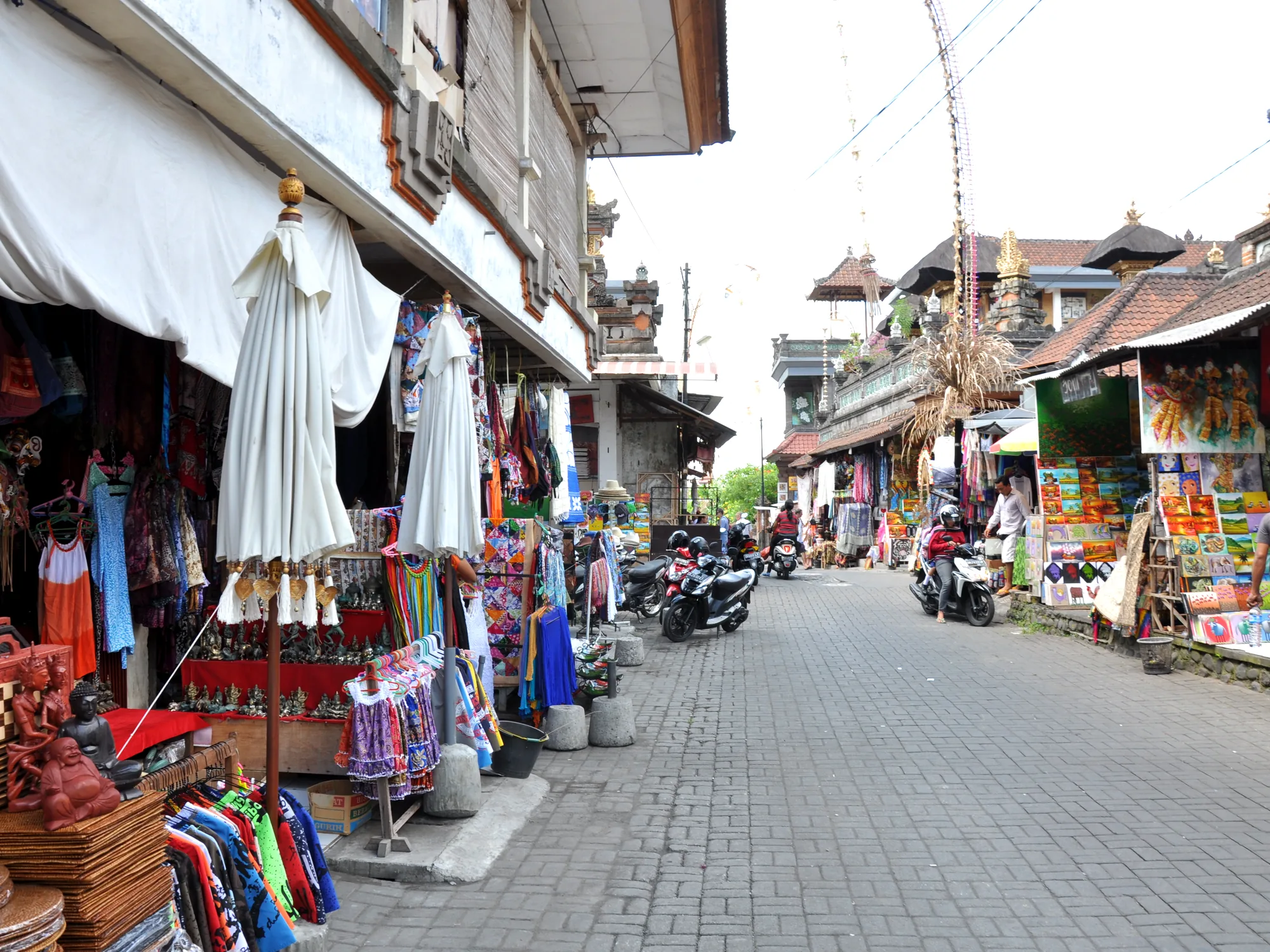
Three markets cover the essentials. Ubud market, opposite the palace, opens every day: fresh produce early in the morning, crafts afterwards. The Sukawati art market, between Denpasar and Ubud, also opens every day. In Denpasar, Kumbasari market, on the banks of the Badung river, sells fabrics and crafts every day.
| Market | Where | Days | For what |
|---|---|---|---|
| Ubud market | Center of Ubud, opposite the palace | Every day | Fruit, offering flowers in the morning; sarongs and objects afterwards |
| Sukawati art market | Sukawati, on the road to Ubud | Every day | Textiles, wickerwork, wood, at wholesale prices |
| Kumbasari | Denpasar, on the banks of the Badung river | Every day | Fabrics, kebaya, ceremonial objects |
The best time for a food market is dawn, when women buy flowers and leaves for the day’s offerings; jaje, the rice cakes used in offerings, are sold there too, see Balinese food. They are very lively before Galungan. Budget ranges for meals and everyday purchases are in Bali travel budget.
How to buy and haggle without getting ripped off
At the market, the first price quoted leaves a margin. Go round the stalls before buying to know the prices, offer much less, then go up in steps, while smiling. Do not make an offer if you are not ready to pay that price. In shops with displayed prices and in cooperatives, you do not haggle.
- Compare three stalls for the same object before asking for a price.
- Ask the price without showing too much interest, then take time to think.
- Make a much lower counter-offer, and go up in small steps.
- If the gap is still too wide, say thank you and leave: the last offer often comes at that moment.
- Pay in rupiah, counting the zeros: IDR 50,000 and 500,000 are easily confused.
- Silver: ask for the hallmark, 925 for solid silver, and a price per gram to compare between workshops.
- Fabric: real hand weaving can be seen on the reverse side, where the pattern threads show.
Planning a day with the craftspeople
Half a day is enough for the craft route between Denpasar and Ubud, with a driver and two or three chosen stops. Keep a separate day for Sidemen and Tenganan, in the east. Avoid major festival days for family workshops, which are often closed, but make the most of the markets beforehand.
- From the south, do the villages on the way up to Ubud, in the morning, before the heat and the traffic jams.
- From Ubud, keep Mas and Batuan, very close by, for a late afternoon, then a dance in the evening: see Balinese music and dance.
- In the east, combine Sidemen, Tenganan and the Klungkung palace for Kamasan painting.
To find out whether a festival falls during your stay, check the festival calendar: in June, the Denpasar arts festival also displays crafts from all over the island, see Bali in June; for the rites that often cross the craft route, see Bali ceremonies and cremations.
Frequently asked questions
Where can you buy authentic crafts in Bali?
In the village workshops: Celuk for silver, Mas for wood, Batubulan for stone, Sidemen and Tenganan for textiles. The markets also sell objects made elsewhere.
Should you haggle in Bali?
Yes at the market and with street sellers, no in shops with displayed prices and in cooperatives. Keep smiling and do not make an offer you would not stand by.
Which days is Ubud market open?
Every day. Fresh produce and offering flowers are sold early in the morning; crafts take over during the day.
What is Tenganan geringsing?
A double ikat fabric: warp and weft are dyed before weaving. It takes months of work, is used for ceremonies and is made in very few places in the world.
Can you bring back a Batubulan stone statue?
Yes, but large pieces go by freight, often more expensive than the statue. Ask for a shipping quote before buying.
Sources
Figures and rules checked on October 17, 2026 against the sources below. Entry rules and fees change: always check them on the official websites before you leave.